How to Verify Authentic Saffron Before You Buy: A Luxury Connoisseur’s Guide to Grade, Provenance and Purity
Somewhere between the market stall and the Michelin pass, the world’s most valuable spice is quietly being counterfeited on an industrial scale. A systematic review published in Critical Reviews in Food Science and Nutrition (2025) estimates that 20–30% of commercial saffron is adulterated — rising as high as 60% in poorly regulated markets. For the connoisseur, verification is not a party trick. It is due diligence.
Why Saffron Fraud Persists — and Why It Matters at the Top of the Market
Saffron earns its reputation as “red gold” honestly. Each crocus flower yields just three crimson stigmas, all hand-harvested within a brief autumn window, which is why premium grades command USD 3,000–7,500 per kilogram and beyond. That scarcity is precisely what invites fraud. When a gram of the finest threads can outprice the same weight of many precious metals, the incentive to dilute, dye or substitute is enormous.
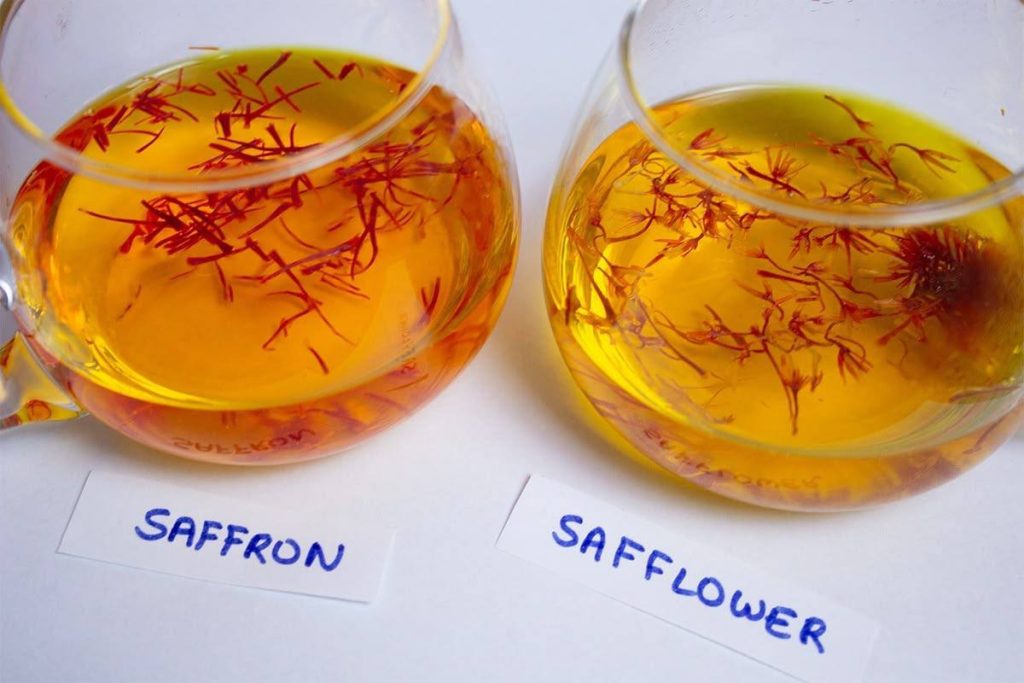
The methods are well documented: substitution with safflower, marigold or turmeric; padding with tasteless plant fibres; and, most concerning, colouring with synthetic dyes. The luxury buyer faces a subtler risk than the obvious fake — not the crude bundle of dyed corn silk, but the genuine-but-mediocre thread sold at an elite price. Authentication, therefore, must verify two things at once: that the saffron is real, and that it is the grade its price implies.
The problem is intensifying rather than fading. As the global saffron market expands and an ever-greater share of buying moves online, the physical cues a discerning shopper once relied upon at a specialist merchant’s counter — touch, aroma, the merchant’s own reputation — disappear behind a product photograph and a marketing paragraph. Distance favours the counterfeiter. That is exactly why a repeatable verification method, applied on arrival and backed by documentation, has become indispensable for anyone spending seriously on this ingredient.
The Four Sensory Tests Every Buyer Should Know
Before any paperwork, the threads themselves tell a story. These checks are simple, immediate and remarkably reliable when read together rather than in isolation.
1. The cold-water test (the definitive one)
Steep a few threads in cold water and watch closely. Authentic saffron releases its golden-yellow colour slowly, over ten to fifteen minutes, while the threads themselves stay red. A counterfeit dyed with synthetic colour bleeds red almost instantly and often disintegrates. Genuine crocin — the pigment responsible for saffron’s colour — diffuses gradually; cheap dye does not.
2. Aroma
True saffron carries a complex bouquet often described as honey and fresh hay, with an almost metallic depth. If the scent is aggressively sweet, reminiscent of artificial fruit, or absent altogether, treat it as a warning.
3. Morphology
Under close inspection, each authentic stigma is trumpet-shaped, flaring to a serrated, bulbous end. Threads that are uniformly flat, glossy, or suspiciously identical suggest machine-cut imitation rather than a hand-harvested flower.
4. The paper-rub test
Rub a dry thread firmly between two sheets of white paper. Real saffron leaves no oily, greasy smear. A coloured or oily residue points to added dye or coating.
Beyond Real vs. Fake: Understanding Grade
A thread can pass every purity test and still be ordinary. This is where discerning buyers separate themselves from the crowd. Saffron quality is defined chiefly by colouring strength — the concentration of crocin, measured spectrophotometrically — alongside flavour (picrocrocin) and aroma (safranal). The higher the colouring strength, the deeper the hue and the more economical the spice in the pan.
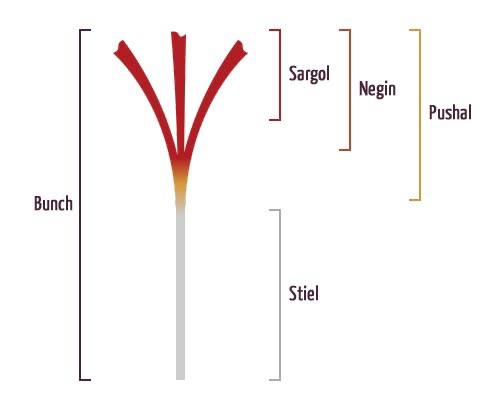
At the summit sits Grade 1 Super Negin: long, thick, all-red threads with the style (the pale lower portion) removed entirely, delivering the highest colouring strength available. Negin follows, then the finer Sargol, with lower grades carrying more style and weaker performance. When a listing simply says “premium saffron” without naming a grade, the omission is itself informative. For a full breakdown, see our definitive Super Negin buyer’s guide.
In practice, grade is where value is either delivered or quietly lost. A higher colouring strength means fewer threads are needed to achieve the same depth of colour and flavour, so the apparently expensive tin of true Grade 1 can prove more economical per dish than a cheaper, weaker grade. The informed buyer therefore asks a precise question — not merely “is this real saffron?” but “what is its grade, and what colouring strength does it deliver?” A seller who cannot answer clearly is telling you something about the product without meaning to.
Consider the practical stakes. A saffron risotto for eight, or a signature dessert on a tasting menu, can hinge on a pinch weighing a fraction of a gram; get the ingredient wrong and the dish is not merely diminished but misrepresented. For a professional kitchen, an inferior thread quietly erodes the very reputation the ingredient was meant to elevate. For the private buyer, it turns a considered indulgence into a disappointment. The cost of a counterfeit is rarely the money alone — it is the occasion it was bought to honour.
The New Frontier: Provenance and Traceability
Sensory tests confirm what a thread is; they cannot confirm where it came from, how it was grown, or whether its supply chain is sound. In 2026, the most sophisticated buyers treat verifiable provenance as the final and highest tier of authentication. A reputable house should be able to show an unbroken chain of custody from harvest to hand — harvest batch, processing record and independently verified quality data.
This is where technology has reshaped the luxury conversation. Blockchain-backed traceability now allows each batch to carry an immutable digital record, while precision cultivation — including data-driven hydroponic systems — brings consistency and environmental accountability to a crop long dependent on the vagaries of a single season. Provenance is no longer a romantic footnote; it is the buyer’s strongest guarantee.
Quick answer: How can I tell if saffron is real before buying?
Steep a few threads in cold water: authentic saffron releases a golden-yellow colour slowly over 10–15 minutes while the threads stay red, whereas dyed imitations bleed red instantly. Confirm with a honey-and-hay aroma, trumpet-shaped red threads, and no oily residue on paper. For a premium purchase, go further — insist on a stated grade (Grade 1 Super Negin is highest) and documented, traceable provenance from the seller.
The Connoisseur’s Checklist
Before committing to a premium purchase, a disciplined buyer confirms all of the following: the seller names a specific grade rather than a vague “premium” label; the threads are all-red, trumpet-shaped and uniform in quality; the aroma is complex and hay-like, never chemically sweet; the cold-water test releases colour gradually; and the supplier can produce genuine provenance documentation and a clear chain of custody. Meeting four of five is reassuring. Meeting all five is the mark of a house worth your loyalty.
Buy With Certainty
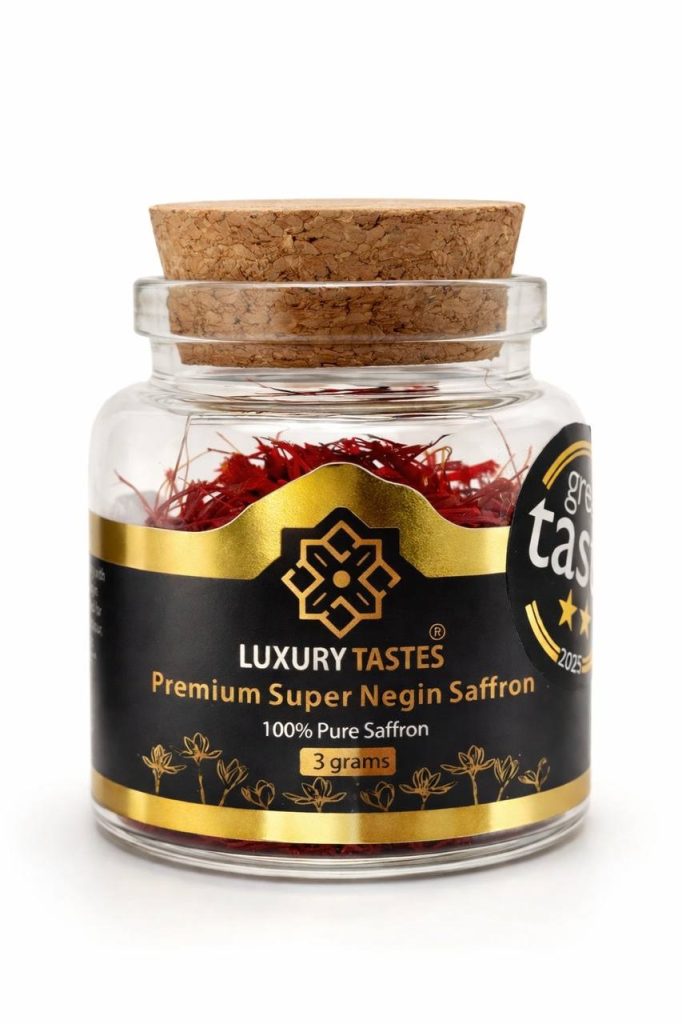
Authentication should never be the buyer’s burden alone — it should be the seller’s promise. At Luxury Tastes, every thread is Great Taste Award-winning, all-red Grade 1 Super Negin, fully traceable and independently verified for quality. Explore our Grade 1 Super Negin saffron collection and taste the difference that verified provenance makes. When the finest is the only acceptable standard, certainty is not a luxury — it is the least you should expect.
About the Author: Behdad Gitinezhad, PhD, CMgr, is the Founder and R&D Executive of Green Trade Chain Ltd. As a Chartered Manager (CMgr) with a PhD in Industrial Engineering, his research focuses on integrating advanced industrial systems and AI-driven frameworks to automate the production and optimisation of high-value botanical and mineral commodities.