
The Geometry of Seasoning: An Industrial Systems Approach to Kosher Salt
In professional gastronomy and large-scale food manufacturing, salt is treated not just as a flavour enhancer, but as a critical functional ingredient. Among the various mineral structures utilised in the industry, Kosher Salt stands as the undisputed workhorse of the professional kitchen. However, from the perspective of Industrial Engineering, the value of kosher salt does not lie in its chemical purity—which is nearly identical to standard table salt—but in its structural morphology and surface area mechanics.
To dominate the premium food sector, one must understand the thermodynamic and physical behaviors of salt crystals. This technical analysis explores the industrial manufacturing, crystalline geometry, and culinary fluid dynamics of kosher salt, demonstrating how structural design influences global taste standards.
1. The Physical Architecture: Flakes vs. Cubes
The fundamental difference between kosher salt and granulated table salt lies in the crystallization process. Standard table salt undergoes a forced vacuum-evaporation process that yields dense, perfectly cubic crystals. In contrast, kosher salt is engineered to have a coarse, flat, or hollow pyramidal structure.
There are two primary industrial methods used to achieve this geometry:
- The Alberger Process: A mechanical technique where purified brine is brought to a pre-heating stage and evaporated in open pans. The salt crystals form on the surface as delicate, hollow flakes.
- The Rolling Process: Extracted solar or rock salt crystals are mechanically compressed between heavy rollers to flatten the cubic lattice into coarse flakes.
The Surface Area to Mass Ratio (SA:M)
According to structural mineralogy profiles archived by Britannica, the open, porous geometry of a kosher salt flake drastically increases its surface area relative to its mass.

This high ratio directly impacts two critical physical behaviors:
- Adherence Dynamics: The flat, irregular surfaces of kosher salt flakes allow them to adhere to the moisture layers of proteins (such as steaks or poultry) far more effectively than smooth, heavy cubes that bounce off.
- Solubility Rate: When introduced to moisture, the thin edges of a flake dissolve rapidly, creating an instantaneous, uniform brine without leaving pockets of undissolved sodium chloride.
2. The Functional Advantage in Food Engineering
The term "Kosher" originates from the traditional Jewish culinary process of dry-brining meat to remove surface blood. Because of the flake's unique morphology, it extracts moisture through osmosis at a highly controlled rate, dissolving into the meat's natural juices without over-salting the interior fibers.
Professional Precision and Density Variability
For professional chefs and automated food assembly lines, kosher salt offers a massive safety margin. Because the flakes are hollow and coarse, a tablespoon of kosher salt contains significantly less sodium mass than a tablespoon of dense table salt.
- 1 Tablespoon of Table Salt ~ 18 to 20 grams of mass.
- 1 Tablespoon of Kosher Salt (Alberger/Flaked) ~ 10 to 14 grams of mass.
This density differential prevents catastrophic over-seasoning in high-pressure Michelin-starred environments, where chefs season by feel and touch rather than static weight metrics.
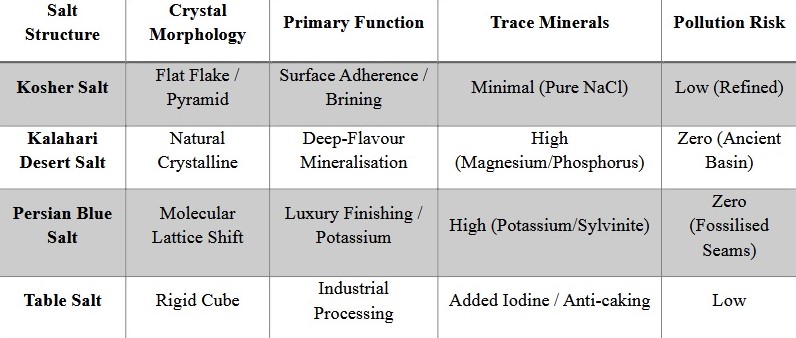
3. The Mineral Hierarchy: Where Kosher Meets Exotic
While kosher salt is prized for its structural utility, it lacks the complex mineral density found in ancient fossilized or desert salts.
4. Advanced Synergy: Elevating Crystalline Geometry with Saffron
At Green Trade Chain Ltd, our R&D objective is to apply Agri-Tech Infrastructure to traditional commodities, creating superior functional hybrids. While kosher salt excels at structural adherence, we recognized that combining high-surface-area physics with premium active botanicals could create the ultimate finishing medium.
This realization led to the development of the Luxury Tastes Saffron Desert Salt.
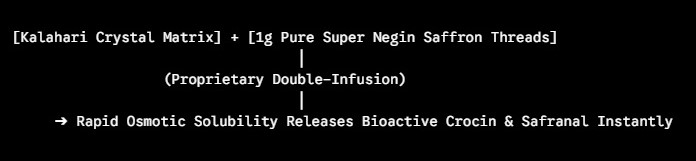
Instead of using standard refined sodium, we utilize pristine Kalahari Desert salt, which is naturally structured to prevent microplastic contamination. We then double-infuse this matrix with 1g of Pure Super Negin Saffron threads—the highest grade evaluated for Crocin (color) and Safranal (aroma) under rigorous chromatographic standards.
When processed through our Refillable Gourmet Spice Mill, the mechanical shear shatters the double-infused crystal lattice. Just like kosher salt, it dissolves instantly upon contact with hot proteins, but with an engineered bonus: it coats the surface with a uniform, crimson-gold aesthetic and unlocks the neuroprotective, antioxidant benefits of premium saffron.
5. Quality Control and Compliance in the Supply Chain
As a modern luxury brand, scaling these mineral frameworks requires strict engineering compliance. Traditional salt packaging lines often suffer from mass fluctuations and structural degradation during transit.
By implementing Statistical Process Control (SPC) and automated weight calibration, our supply chain ensures that the crystalline integrity of our artisan products is preserved from the mining source to the global export market. This focus on traceability and structural engineering is what differentiates a standard kitchen commodity from a globally respected premium experience.
Conclusion: The Structural Choice
Kosher salt proves that in the culinary arts, physics is just as important as chemistry. The geometric shape of a salt crystal dictates how it dissolves, how it adheres, and ultimately, how it flavors. By mastering these structural dynamics, Luxury Tastes continues to push the boundaries of premium gastronomy, merging ancient mineral heritage with modern technical execution.
About the Author: Behdad Gitinezhad, PhD, CMgr, is the Founder and R&D Executive of Green Trade Chain Ltd. As a Chartered Manager (CMgr) with a PhD in Industrial Engineering, his research focuses on integrating advanced industrial systems and AI-driven frameworks to automate the production and optimisation of high-value botanical and mineral commodities.