
The Provenance Revolution: Why Traceability Now Defines True Luxury in Fine Food
A gold-rimmed tin without a story is merely packaging. In 2026, the world's most discerning buyers no longer begin by asking what an ingredient costs; they ask where it has been, who touched it, and whether every claim on the label can be proved.
Provenance Has Become the Ultimate Luxury Credential
For most of the twentieth century, luxury food traded on mystique. A hand-lettered label, a whispered origin, a house name — that was the guarantee. The twenty-first-century connoisseur is a different creature: informed, sceptical and armed with a smartphone. In this new landscape, verified provenance is the new gold standard, and opacity — once romantic — now reads as a warning sign.
The market has moved decisively. The global blockchain-in-food sector crossed the $1.5 billion mark in 2026, and market analysts at Mordor Intelligence project the wider blockchain supply chain market to grow from $1.77 billion in 2026 to $12.41 billion by 2031 — a compound annual growth rate of nearly 48 per cent. When Walmart requires blockchain-tracked provenance from produce suppliers and Carrefour verifies more than thirty product categories on distributed ledgers, transparency is no longer an avant-garde experiment. It is the direction of travel for the entire food economy — and the luxury tier, where a single gram of saffron can command more than the equivalent weight of gold leaf, has the most to gain and the most to prove.
What Traceability Really Means: From Crocus Field to Kitchen
The chain of custody
True traceability is not a certificate framed on a wall. It is an unbroken, tamper-proof chain of custody: the named harvest region, the picking date, the drying conditions, the batch number, the export documentation, and the hands the product passed through on its way to your kitchen. Each link either strengthens or breaks the story. For saffron — the most frequently adulterated high-value ingredient in the world — a single missing link is where safflower petals, dyed corn silk or last season's stock quietly enter the supply chain.
The immutable ledger
This is where distributed ledger technology earns its place in the luxury larder. Peer-reviewed research published in Frontiers in Sustainable Food Systems (2026) demonstrates that permissioned blockchain frameworks allow every participant in an agricultural supply chain to write to a shared record that none can alter retrospectively — compressing trace-back investigations from weeks to seconds and measurably increasing consumer trust. For the buyer, the practical effect is simple and profound: the story on the label becomes a fact you can check, not a claim you must take on faith.
How Can You Verify the Provenance of Premium Saffron Before You Buy?
To verify the provenance of premium saffron, ask for five things: a recent, dated certificate of analysis showing crocin (colour), picrocrocin (taste) and safranal (aroma) values; a named harvest region and harvest date, not just a country of dispatch; a batch number that ties your jar to a specific lot; a transparent chain of custody from grower to seller; and a plausible price. Grade 1 saffron trades at roughly $3,000 to $4,000 per kilogram at wholesale, so deeply discounted 'premium' saffron is almost always adulterated, aged or misgraded. A reputable house will provide all five without hesitation — and increasingly, will let you confirm them yourself with a scan of the jar.
Commit those five checks to memory and they will serve you equally well for caviar, truffles and rare salts. The pattern of authenticity is universal; only the commodity changes. It is also worth remembering what the checks are protecting you from: independent surveys of retail saffron across Europe have repeatedly found significant proportions of samples misgraded or adulterated, which is precisely why documentation — not colour alone, and certainly not price alone — is the discerning buyer's first instrument.
Why Caviar Set the Template — and What Saffron Is Learning From It
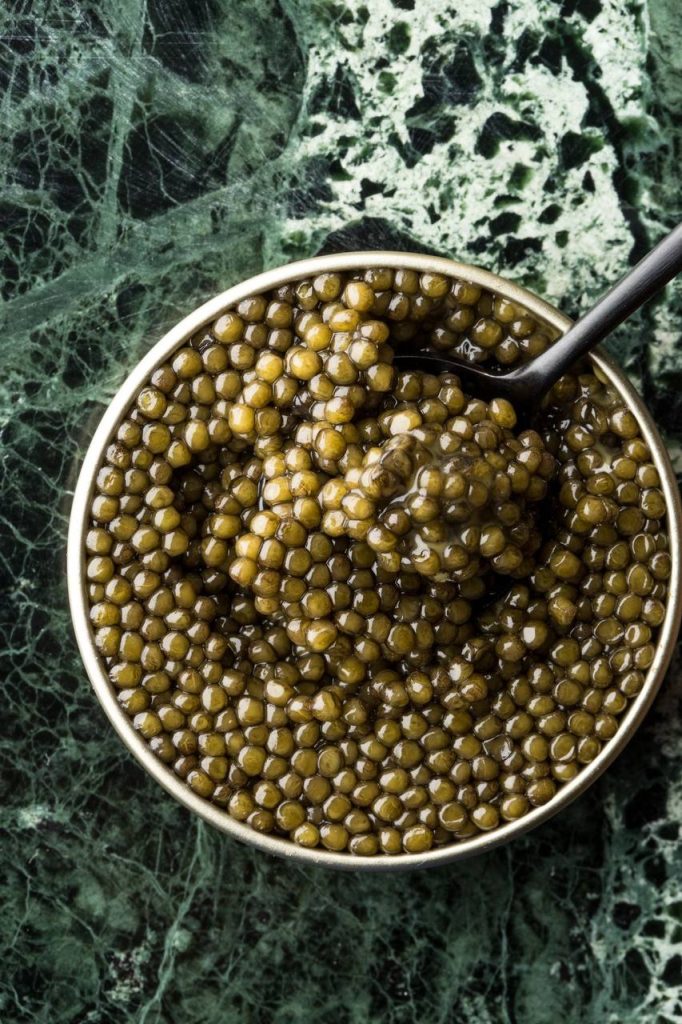
If you want to see where luxury food traceability is heading, look at where caviar has already been. When wild sturgeon populations collapsed at the end of the last century, the international community responded with one of the most rigorous provenance regimes in gastronomy: since 1998, every legal tin of caviar crossing a border must carry a CITES labelling code identifying the species, the country of origin, the year of harvest and the processing plant. What began as a conservation necessity became, within a generation, a mark of distinction — today's finest aquaculture houses compete openly on the transparency of their farms, their water quality and their feed, because the buyers who spend the most are precisely the buyers who check.
Saffron is now undergoing the same transformation, a generation later and at digital speed. The crocus has no CITES committee, so the market is building its own regime from better instruments: spectral analysis that fingerprints a harvest's chemical signature, batch-level QR provenance, and ledger-backed export records. The lesson from caviar is unambiguous. Far from diminishing the romance of a rare ingredient, rigorous traceability deepens it — because a story that survives verification is a story worth telling at the table.
Sustainability and Traceability: Two Sides of the Same Coin
There is a quiet revolution hidden inside the provenance movement: you cannot verify what you cannot trace, and therefore sustainability without traceability is merely marketing. A carbon claim, a water-stewardship pledge, a fair-labour commitment — each is only as credible as the data trail behind it. This is why the most forward-looking producers are pairing renewable energy and circular packaging with the digital infrastructure to prove both.
Controlled-environment growing is the clearest example. Precision hydroponic saffron cultivation allows every input — water, nutrients, light, energy — to be measured, logged and audited, turning environmental responsibility from a brochure promise into a dataset. It also conserves dramatically scarce resources: controlled-environment agriculture can reduce water consumption by up to 90 per cent compared with open-field irrigation, a figure that matters profoundly for a crop historically grown in water-stressed regions. We explored the technology in depth in our journal feature on hydroponic saffron cultivation; the essential point here is that the same sensors that optimise a harvest also authenticate it.
The House Standard: How Luxury Tastes Applies the Provenance Principle

At Luxury Tastes, we hold a simple conviction: every jar must tell its full story, and every part of that story must be checkable. Our Grade 1 Super Negin saffron — awarded two stars at the Great Taste Awards 2025, placing it in the top ten per cent of more than 14,000 products blind-tasted by over 500 chefs, critics and buyers — carries its provenance openly: named origin, harvest window, batch identity and independent quality analysis. The same discipline governs our 280-million-year-old Kalahari Desert salt and the sourcing standards behind our caviar service, which we detailed in last week's conscious connoisseur's guide to sustainable caviar.
This is what we believe the next decade of luxury food looks like: cultural heritage carried forward by cutting-edge verification, so that the romance of a centuries-old spice and the rigour of a modern supply chain finally speak with one voice.
The Discerning Choice
Provenance is no longer the fine print of luxury; it is the headline. The next time an ingredient asks for a place at your table, ask for its story first — and expect that story to be proven, not merely told. Begin with the ingredient that started it all: explore our fully traceable Grade 1 Super Negin saffron collection at www.luxurytastes.com — where every thread carries its history, and every history stands up to scrutiny.
About the Author: Behdad Gitinezhad, PhD, CMgr, is the Founder and R&D Executive of Green Trade Chain Ltd. As a Chartered Manager (CMgr) with a PhD in Industrial Engineering, his research focuses on integrating advanced industrial systems and AI-driven frameworks to automate the production and optimisation of high-value botanical and mineral commodities.